


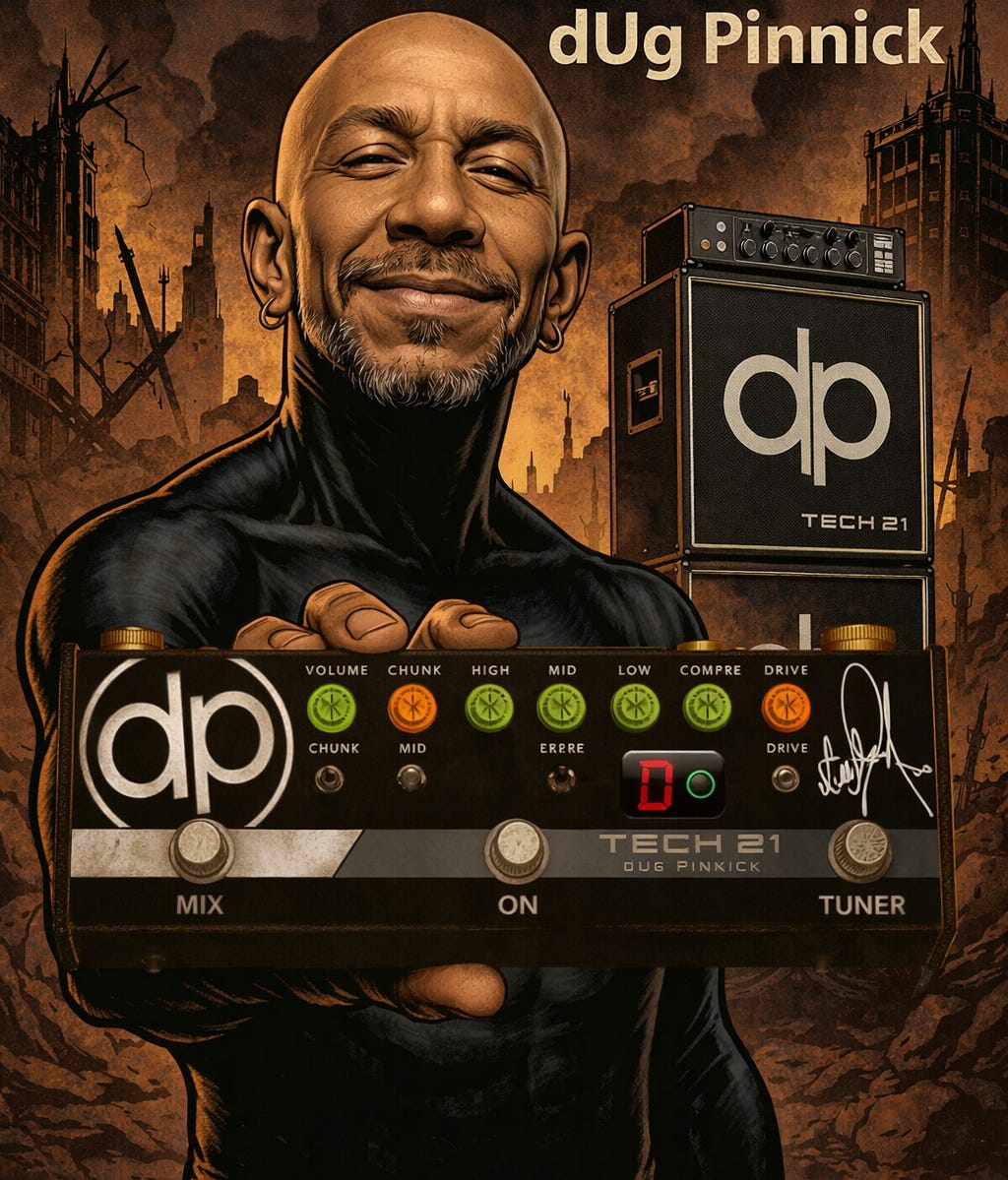
For most bass players, the dream is simple.
Find a great bass.
Find a great amp.
Find a sound you love.
Then spend the rest of your life trying not to lose it.
Dug Pinnick had a different problem. His sound was too big.
Not physically. Spiritually. Emotionally. Sonically.
Dug’s bass tone was never designed for convenience.
It was designed to move air.
Lots of it.
The kind of sound that makes your pant legs flap.
The kind of sound that feels less like hearing music and more like standing next to a freight train carrying gospel records and Marshall stacks.
For decades, that sound lived inside enormous rigs.
Towering speaker cabinets. Power amplifiers. Rack systems.
Processing gear. Cables. Road cases. Truck space. Crew members.
The entire ecosystem required to support one of the most recognizable bass sounds in modern rock.
And then somebody at Tech 21 asked a dangerous question.
“What if we could fit all of that into a pedal?”
Most people would laugh.
Dug probably did too.
Because what they were talking about wasn’t simply recreating an EQ curve.
They were talking about recreating a personality.
And that changes everything.
Before the Pedal, There Was the Wall
To understand the DP-3X, you first have to understand the problem.
Dug Pinnick’s tone was never a traditional bass sound.
Even from the earliest King’s X records, listeners noticed something different.
The bass wasn’t sitting underneath the band.
The bass was standing beside the guitar.
Sometimes it felt like it was arguing with the guitar.
Sometimes it felt like it was replacing the guitar.
Sometimes it felt like it was carrying the entire emotional weight of the song.
That tone became one of the defining sounds of King’s X. Huge. Distorted. Aggressive.
Yet somehow warm and musical. That’s harder than it sounds.
Most distorted bass tones lose their low end.
Others become muddy. Others become harsh.
Dug’s tone somehow stayed enormous while remaining clear enough to support complex vocal harmonies and intricate arrangements.
That wasn’t an accident.
It was years of experimentation.
Years of chasing sounds.
Years of discovering how to combine power and clarity.
The result became one of the most copied bass tones in rock.
And one of the hardest to duplicate.
Enter Tech 21
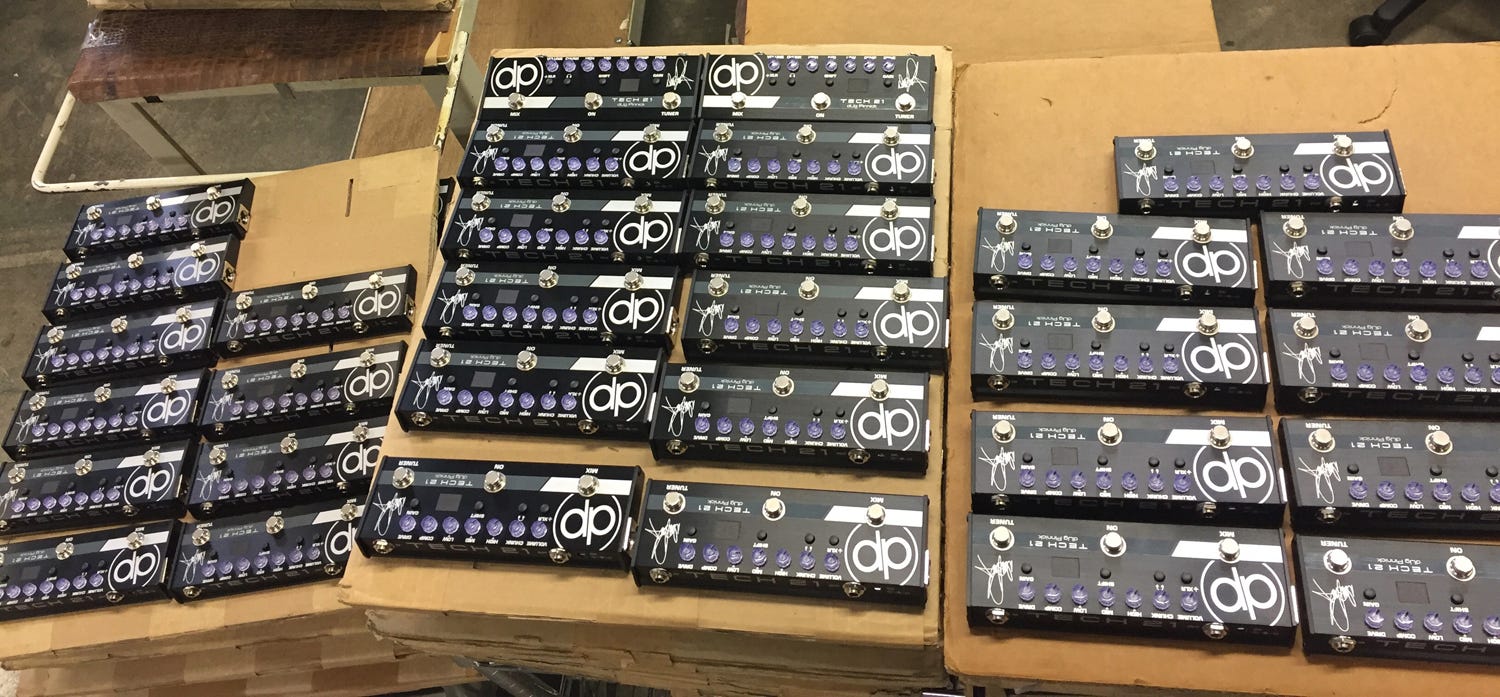
If there was ever a company built for this challenge, it was Tech 21.
Founded by Andrew Barta in New York City, Tech 21 built its reputation on a radical idea.
You shouldn’t need a truck full of gear to sound great.
The company’s SansAmp technology changed the industry by allowing musicians to achieve amplifier-like tones without relying entirely on traditional amplifiers.
That concept seems normal today. It wasn’t normal then.
In many ways, Tech 21 was already in the business of shrinking impossible things.
Classic tube amplifiers. Vintage recording chains.
Massive studio sounds. All reduced to practical, portable tools.
So when Dug Pinnick entered the picture, the mission was obvious. And terrifying.
Because nobody wanted a pedal that sounded “kind of like Dug.” The goal was Dug.
Or as close as physics would allow. Capturing a Voice
One of the biggest misconceptions about signature gear is that it is simply designed around settings. Turn this knob. Boost this frequency. Cut that frequency.
Done.
Real signature products don’t work that way.
The best signature gear captures behavior. Personality. Reaction.
Feel.
Dug’s sound isn’t just about distortion.
It’s about what happens when clean and dirty tones collide.
It’s about the attack.
The grind.
The low-end authority.
The upper harmonic content.
The way chords bloom.
The way single notes growl.
The way the bass occupies a space that most bass players aren’t brave enough to occupy.
The engineers at Tech 21 weren’t cloning a tone. They were chasing a phenomenon. The DP-3X Arrives.
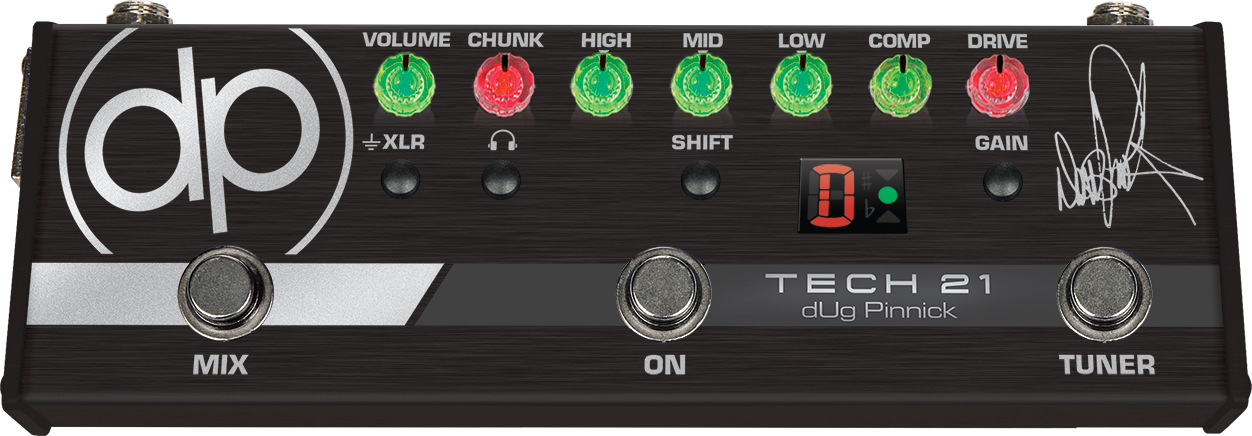
And suddenly something remarkable happened. The giant rig became portable.
Not smaller. Portable. There is a difference.
Many products shrink a sound and lose the magic. The DP-3X felt different.
Players immediately recognized the DNA. The massive low end. The aggressive grind.
The ability to blend clean authority with overdriven attitude.
The unmistakable voice that had become synonymous with Dug Pinnick.
For countless bass players, it was the first time they could access that sonic universe without needing an arena-sized equipment budget. That mattered. Because the DP-3X wasn’t marketed as a toy. It was a professional tool. The same way Dug approaches music. No gimmicks. No shortcuts. Just results.
Why the DP-3X Matters
The true genius of the DP-3X isn’t that it sounds like Dug.
The true genius is that it teaches players why Dug sounds like Dug.
When you plug into one, you begin to understand the architecture of the tone.
The relationship between clean and dirty signals.
The importance of low-end preservation.
The role of harmonic saturation.
The balance between aggression and clarity.
You start hearing the decisions behind the sound.
And that’s where real education happens.
Not in a manual.
Not in a YouTube demo.
In your ears.
The Beautiful Irony
There is something wonderfully ironic about the entire story.
Dug Pinnick spent decades building one of the biggest bass sounds in rock.
A sound associated with giant stages, giant amps, giant speakers, and giant emotions.
Then Tech 21 managed to fit much of that philosophy into something small enough to sit in the front pocket of a gig bag.
That’s like taking a thunderstorm and putting it in a lunchbox.
A mountain in a pedal.
A wall of sound in a metal box.
And somehow it works.
More Than Gear
The Dug Pinnick and Tech 21 story is ultimately about something bigger than equipment.
It’s about accessibility.
It’s about preserving a musical voice.
It’s about making decades of experimentation available to the next generation.
Because every once in a while, a piece of gear becomes more than a product.
It becomes a bridge.
A bridge between one musician’s lifetime of discovery and another musician’s future possibilities.
The DP-3X is one of those bridges.
And that’s why it remains one of the most fascinating signature products ever created.
Not because it sounds like Dug Pinnick.
But because it reminds us why Dug Pinnick’s sound mattered in the first place.
Final 123 Bass Nation Low-End Thought
Most signature pedals promise a tone.
The DP-3X promises an attitude.
The attitude that bass can be bigger.
Dirtier.
More emotional.
More fearless.
More expressive.
More alive.
The attitude that the bass doesn’t have to stay in the background.
The attitude that helped Dug Pinnick change the way generations of players think about the instrument.
Tech 21 didn’t simply build Dug a pedal.
They built a portable version of a philosophy.
And somehow, against all odds, they managed to fit a mountain inside.
123 BASS NATION